Short answer: For most Vancouver garages, use both: a 100% solids epoxy base coat for adhesion and structural build, with a polyaspartic topcoat for UV stability and durability at the surface. Neither system alone performs as well as the combination. Below is why, and when the answer changes.
Contractors selling polyaspartic will tell you it is always the better system. Contractors selling epoxy will say epoxy is all you need. The honest answer sits in the middle, and it is specific to your garage, your slab, and what matters most to you.
This guide covers how epoxy and polyaspartic actually compare for a Vancouver BC garage floor: cure time, UV stability, cold-weather performance, cost, and the system question most contractors avoid answering. We install both, and we have a commercial interest in selling whichever one costs more. That is why we want to be straightforward about when each one is and isn't worth it.
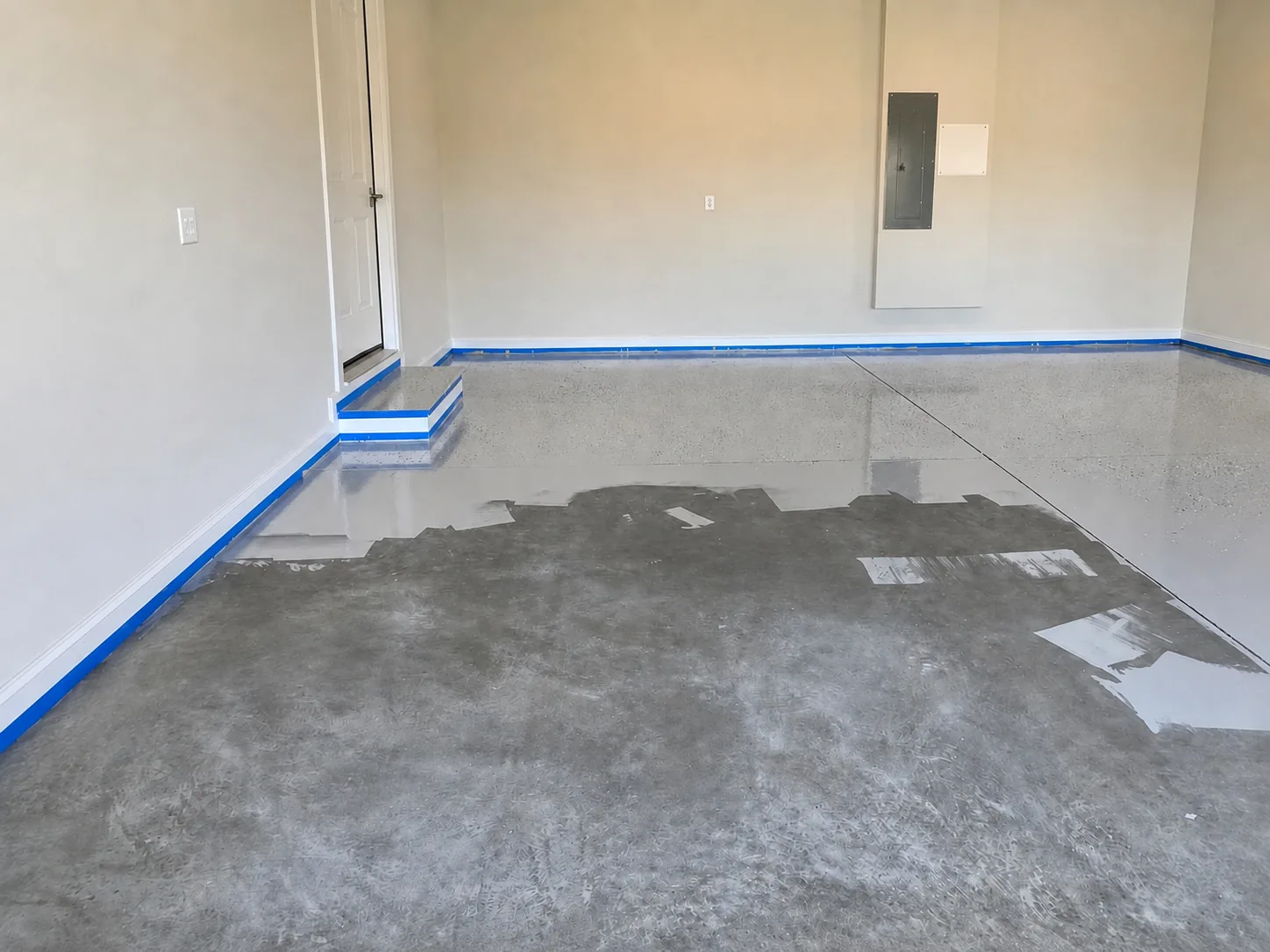
What Is Epoxy?
Epoxy is a two-part thermosetting resin: a resin and a hardener that, when mixed, cross-link to form a rigid, plastic-like material that bonds to properly prepared concrete. It has been the standard for garage floor coatings for decades, and it earned that reputation. A professionally installed 100% solids epoxy system (not the water-based kits from the hardware store) creates a hard, chemical-resistant surface that handles vehicle traffic, oil drips, and road salt effectively.
Epoxy's main limitations are cure time and UV sensitivity. It cures slowly relative to newer coating systems, with light foot traffic usually after about 24 hours, vehicles after about 72 hours, and full cure in about 7 days. And epoxy uses aromatic chemistry that reacts to ultraviolet light, so it will yellow and amber over time when exposed to sunlight. For an interior space with no direct sun exposure, yellowing is rarely noticeable. For a garage with a south-facing door that sits open most of the day, it can become visible within a few years.
What Is Polyaspartic?
Polyaspartic is a newer aliphatic polyurea coating that cures significantly faster than epoxy and is UV-stable by design. The aliphatic chemistry means it does not react to ultraviolet light: the colour you install is the colour you keep, year after year, regardless of sun exposure. It also tolerates lower application temperatures than standard epoxy, which makes it more practical for late fall and early spring installs in Vancouver garages that may not be heated.
The tradeoff is that polyaspartic's fast cure, its biggest selling point, is also its most demanding characteristic during installation. It requires installers to move quickly and precisely. Poorly timed application creates lap marks, uneven texture, and adhesion problems. This is why one-day polyaspartic installations from less-experienced contractors produce inconsistent results: the coating chemistry is less forgiving of slow or inexact application.
The Five Key Differences for Vancouver Garages
| Factor | Epoxy | Polyaspartic |
|---|---|---|
| Cure time to vehicle traffic | About 72 hours | About 24 hours |
| UV stability | Yellows over time | UV-stable, resists yellowing |
| Application temperature | Min ~10°C | Tolerates lower temps |
| Material cost | Lower ($5 to $12/sq ft) | Higher end of $6 to $12/sq ft |
| Installation pace | More forgiving | Fast, requires experience |
The Answer Most Contractors Skip: Use Both
The framing of "epoxy vs polyaspartic" misses how most high-quality Vancouver garage floor systems are actually built. The two coatings perform best in different layers of the same installation, and the strongest systems use both.
Epoxy as the base coat provides several advantages at the foundation layer. It cures more slowly, which allows it to penetrate deeper into the prepared concrete profile and build a stronger mechanical bond to the slab. It is also typically applied at higher film build than polyaspartic, which means more material filling the concrete surface and a more substantial structural foundation for the system.
Polyaspartic as the topcoat delivers the UV stability, chemical resistance, and abrasion resistance where it matters most: at the surface. The top layer is what sees daily traffic, sunlight, tire marks, and cleaning chemicals. Polyaspartic handles those demands better than a standard epoxy clear coat.
The result is a system that combines the adhesion and build quality of epoxy with the UV stability and durability of polyaspartic. This is the approach we use on most Vancouver residential garage epoxy floors (not as an upsell, but because it is the combination that actually holds up over a decade-plus in BC conditions).
One-day vs multi-day installations: You will see some contractors advertise one-day polyaspartic garage floor installations. On a sound, well-prepared slab, this is achievable. But rushing prep to fit the job into a single day is where problems start. Surface grinding, crack repair, and moisture testing cannot be meaningfully compressed without compromising the result. Any contractor who doesn't discuss moisture testing before a Vancouver garage floor installation, one-day or otherwise, is a red flag.
When Epoxy is the Better Choice
Choose Epoxy When
- Budget is the primary consideration
- The garage has no significant direct sun exposure
- You can allow about a week for the floor to reach full cure
- The slab needs substantial levelling or build-up
- You want a decorative flake system at the most accessible price point
Choose Polyaspartic (or Combo) When
- You need the floor back in use within 24 hours
- The garage door faces south or west with significant sun exposure
- Installation is scheduled in late fall or early spring
- Long-term colour stability matters for your space
- You want the best overall durability and are willing to pay the premium
What Matters More Than the Chemistry
The single factor that most determines whether either system succeeds or fails in a Vancouver garage is not the coating chemistry. It is the quality of surface preparation, and specifically whether the slab was tested for moisture vapour emission before anything was applied.
Metro Vancouver's combination of high water table, Fraser delta soils, and older housing stock without sub-slab vapour barriers creates a market where a significant percentage of residential concrete slabs carry moisture vapour emission rates that will cause coating failure if not addressed. An excellent polyaspartic system applied over an untested, high-moisture slab will delaminate. A well-specified epoxy system with a moisture-mitigating primer on a properly prepared slab will hold for well over a decade. Moisture vapour emission is measured using ASTM F1869 calcium chloride or F2170 relative humidity probe methods, both of which we perform before specifying any system.
This is not to minimize the difference between the two coatings. Those differences are real and worth understanding. But they are secondary to getting the prep right. If a contractor isn't discussing moisture testing before your Vancouver garage floor installation, the chemistry choice is irrelevant.
For a deeper look at moisture vapour and why it matters specifically in the Lower Mainland, read our guide: Why Epoxy Floors Fail in Vancouver: Moisture Vapour, Hydrostatic Pressure & What to Do About It.
Cost Comparison for a Typical Vancouver Garage
For a standard two-car Vancouver garage (approximately 400 to 500 sq ft), here is a realistic comparison of the two approaches in 2026:
- Epoxy-only system (diamond grind, moisture test, epoxy primer, epoxy base coat, polyaspartic topcoat, flake broadcast): $2,000 to $4,000
- Polyaspartic-heavy fast-cure system (same prep, polyaspartic base and topcoat, faster return to service): $2,000 to $4,000, toward the upper end
- Combination system (epoxy base, polyaspartic topcoat, most common): $2,000 to $4,000
Surface preparation is included in all estimates above. Moisture mitigation primer, if required by testing, adds $1 to $3 per sq ft to any system. For full pricing details by system and garage size, see our 2026 epoxy flooring cost guide for Vancouver.