Polyaspartic Floor Coatings in Vancouver
Polyaspartic is a fast-curing, UV stable floor coating that resists yellowing, cures in a fraction of the time of solid epoxy, and stands up to BC moisture and daily wear. Our team diamond-grinds the slab and installs durable polyaspartic systems, on their own or as a premium topcoat over a flake or solid base, for Vancouver garages, patios, thresholds, and basements. Because it cures faster than epoxy, it returns to service sooner, with far less downtime. As part of every consultation, we assess whether polyaspartic is the right system for your slab or whether a standard epoxy build offers better value.
What Is Polyaspartic Coating?
Polyaspartic is a high-performance urethane resin floor coating known for fast curing, UV stability, and strong resistance to chemicals, abrasion, and stains. In Vancouver it has become one of the most popular ways to finish a concrete floor on garages, patios, thresholds, and basements, either as a complete system or as a premium topcoat over a flake or solid-colour base.
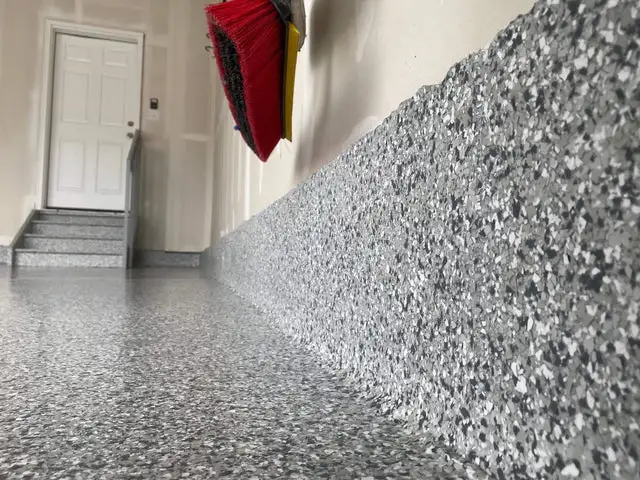
Polyaspartic garage flooring in particular is growing fast across Metro Vancouver because it cures much faster, so a garage is usually back in service in about 24 hours. The result is a joint-free, easy-clean surface that holds up to daily traffic and the Lower Mainland's damp climate.
What sets polyaspartic apart from a standard epoxy is speed and sunlight resistance. It cures in a fraction of the time between coats, so a floor returns to service far sooner than epoxy (many straightforward floors on a sound slab are coated in a day once prep is complete), and it is UV-stable, meaning it strongly resists the yellowing and ambering that affect many epoxies under sunlight.
For Vancouver homeowners who want a durable floor without a multi-day shutdown, and for businesses that cannot afford extended downtime, that combination is a significant advantage. And because coating an existing floor is cosmetic work, the City of Vancouver lists flooring replacement among projects that generally do not require a permit, so a standard installation involves no permitting process.
Polyaspartic vs Epoxy Explained: Which Is Right for Your Vancouver Floor?
This is the most common question we are asked, and the answer is that neither is simply "better". They are different tools suited to different conditions, and the strongest floors often use both. Here is how they compare for a typical Vancouver project:
| Factor | Polyaspartic | Epoxy |
|---|---|---|
| Cure / return to service | Fast, with quick return to service after prep | Slower, typically multiple days |
| UV stability | UV-stable, highly resists yellowing | Can amber or yellow in sunlight |
| Cold-temperature install | Tolerates lower temps, good for BC winters | More temperature-sensitive |
| Build / thickness | Excellent as a tough topcoat | Builds thickness and fills well as a base |
| Cost | Premium | More economical |
The strongest systems usually combine the two: an epoxy or flake base for build and colour, sealed with a polyaspartic topcoat for UV stability and fast return to service. For a deeper technical comparison including cost, cure schedules, and UV performance, see our epoxy vs polyaspartic comparison for Vancouver garages. If you are weighing a full coating against a bare-slab look, you can also compare it with polished concrete or a standard garage epoxy floor.
Where Polyaspartic Coatings Work Best
Polyaspartic's UV stability and fast cure make it especially useful in a few Vancouver-specific situations:
- Garage floors get a tough, hot-tire-resistant finish that resists yellowing near an open door, with a faster return to service than epoxy
- Patios & exterior concrete benefit because UV stability means it holds its look far better in direct Pacific Northwest sun, where epoxy tends to amber
- Thresholds & entryways are bright, sun-exposed transitions that need a coating that stays true to colour
- Basements & utility rooms get a fast, low-odour, easy-clean finish, paired with moisture control for below-grade slabs
- Retail & commercial floors need minimal downtime, since every closed day costs money
When Epoxy Is the Better Choice
The most cost-effective system is not always the most advanced one. A standard epoxy floor is often the better choice for an interior space with no sunlight exposure, where a fast return to service is not critical, or where a thicker build is needed to level a rougher slab. Where that describes your project, we will recommend epoxy. Polyaspartic is not necessary to achieve an excellent, long-lasting floor.
How We Install Polyaspartic Coatings
Fast cure does not mean cutting corners. The preparation is identical to any quality floor, and in Vancouver's damp climate, moisture control is what makes a coating last. Here is how our team works.
A polyaspartic floor is a multi-stage job: surface preparation comes first, then the coats, with cure time between each. A straightforward floor on a sound slab can often be coated in a single day once prep is done, usually back in service in about 24 hours.
Slabs that need extensive grinding, crack repair, or a moisture barrier take longer. We give you a realistic, stage-by-stage timeline with your quote rather than promising a one-day finish that does not suit every floor.
What's in a Polyaspartic Floor
A durable polyaspartic floor is built in layers, from the prepared slab up to the protective topcoat. Each one does a job:
The exact build varies by project. Sometimes the polyaspartic serves as both base and topcoat, and not every floor uses decorative flake. We confirm the right system for your slab at your assessment.
Polyaspartic and Vancouver's Climate
Polyaspartic is well-suited to the Lower Mainland for two reasons. First, it is UV-stable, so it holds its colour far better on patios, thresholds, and garages with open doors, where our long, bright summer days tend to yellow a standard epoxy. Second, it tolerates cooler, damper conditions better than epoxy, which makes it practical to install through more of the Vancouver year.
That said, the same coastal damp that makes a fast, tolerant coating attractive also makes moisture control essential. Vapour rising through a slab is the most common cause of coating failure in the region, so we moisture-test every floor and apply a barrier where readings call for it. We also follow WorkSafeBC guidance on controlling silica dust during grinding, using dust-extraction equipment to keep your home or workplace clean throughout the job.
What Does Polyaspartic Coating Cost in Vancouver?
Most polyaspartic floors in Greater Vancouver fall in the $6 to $12 per sq ft range installed, and every job is quoted as a project rather than at a single flat rate. The main factors are the size and condition of your slab, how much grinding and crack repair it needs, whether moisture mitigation is required, the finish you choose (solid, flake, or as a topcoat over another system), and whether anti-slip is added. A simple one-car garage is very different from a large patio or a commercial floor.
Polyaspartic typically costs more up front than a basic epoxy, but the faster return to service and longer-lasting, yellowing-resistant finish often offset that over time. Because every slab is different, we confirm exact pricing with a free on-site assessment. To compare systems side by side, see our epoxy flooring cost guide.
Polyaspartic Coating Warranty: Coverage by System
Every floor we install is backed by a full written warranty, provided with your quote. We install professional-grade, low-VOC systems from top North American manufacturers, and coverage is tiered by the system you choose.
| System | Exterior | Interior |
|---|---|---|
| 1-Day flake system Polyaspartic base · full flake broadcast · polyaspartic topcoat | 5 years | 10 years |
| 2-Day flake system Epoxy primer · pigmented polyurea base · full flake broadcast · polyaspartic topcoat | 10 years | 20 years |
Coverage includes adhesion failure, delamination, peeling, yellowing or ambering, and hot-tire pickup. Not sure which system fits your floor? Compare the 1-Day and 2-Day flake systems.
Polyaspartic Coating Vancouver: FAQ
Get Your Free Polyaspartic Quote
Tell us about your space and we'll arrange a free on-site assessment across Greater Vancouver, with clear, no-obligation pricing matched to your slab and the finish you want.