Vancouver BC · Food Service Flooring
Commercial Kitchen
Epoxy Flooring Vancouver
Urethane cement and epoxy quartz systems for restaurants, hotel kitchens, and food service facilities across Greater Vancouver. VCH-compliant joint-free surfaces, coved base detail, low-disruption scheduling.
The Problem with Standard Kitchen Floors
Why Standard Epoxy Fails in Commercial Kitchens, and What Replaces It
Commercial kitchens in Vancouver operate in one of the most demanding floor environments in any industry. Thermal cycling from steam cleaning, hot water washdowns, and rapid temperature swings between cooking zones and walk-in coolers creates stresses that standard epoxy systems are not designed to handle. The result on a standard epoxy floor is predictable: delamination, lifting seams, and a surface that becomes impossible to sanitize effectively.
The correct flooring system for a commercial kitchen is urethane cement, also called PU-cement or polyurethane cement. It is a cementitious polymer system applied at 6 to 9mm that remains dimensionally stable through the temperature swings, chemical exposure, and constant moisture that define a restaurant kitchen environment. It is the industry standard for food service floors across Metro Vancouver, and the system Vancouver Coastal Health references in its requirements for joint-free, cleanable commercial kitchen surfaces.
For lighter-duty kitchen environments (bakery prep areas, café counter service, catering staging), epoxy quartz broadcast systems offer a more economical alternative where thermal demands are lower. We assess the specific conditions of each kitchen before specifying a system, because the right choice depends on what the floor actually faces, not a blanket recommendation.
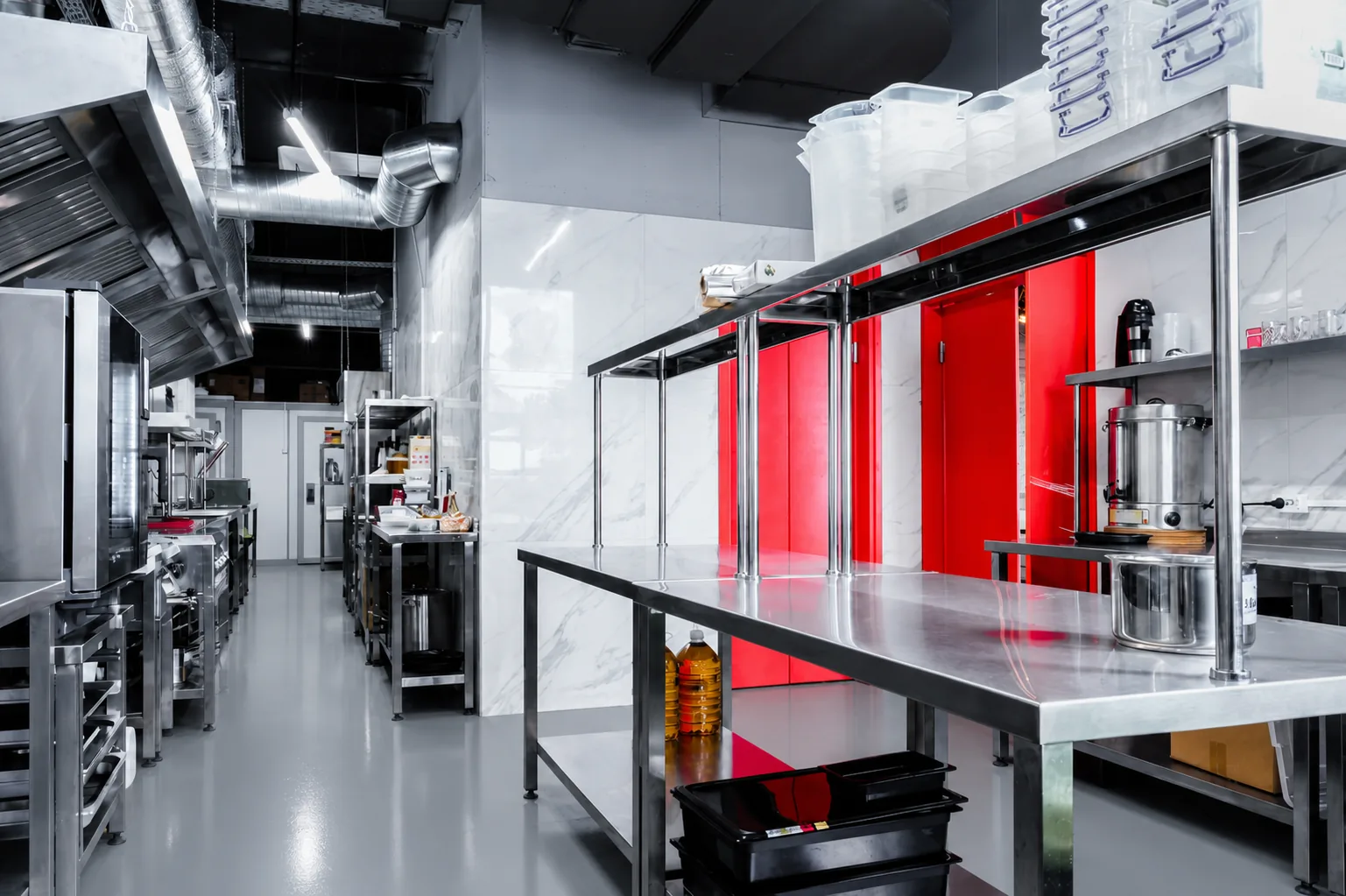
Common Kitchen Floor Failure Modes
What the Wrong Floor Costs a Kitchen
Standard epoxy lifts when steam cleaning hits a cooled surface. The rapid temperature change exceeds the coating's flexibility threshold, breaking the bond from below.
Tile grout is porous, absorbs grease, and cannot be effectively sanitized under Vancouver Coastal Health standards. Failed grout joints become persistent contamination points.
The degreasers, sanitizers, and acid-based cleaners required in commercial kitchen environments degrade standard paint and thin-film coatings within months of regular use.
The right-angle joint between the floor and wall base is impossible to clean effectively with mops or spray equipment. Without a coved base, it accumulates grease and bacteria.
Smooth-finish floors become hazardous under grease and standing water. Non-slip aggregate must be specified to the correct profile for kitchen zones without impeding cleaning.
Vancouver Coastal Health requires joint-free, impervious, cleanable surfaces in food preparation areas. Tile grout, paint coatings, and cracked concrete fail these requirements on inspection.
System Specifications
What a Properly Specified Kitchen Floor Delivers
Urethane cement tolerates rapid temperature swings from steam cleaning and hot water washdowns without delaminating. Tested to withstand the thermal cycling common in active restaurant kitchens.
Resistant to cooking oils, animal fats, acetic acids in food waste, and the degreasers, sanitizers, and alkaline cleaners used in commercial kitchen sanitation protocols.
No grout joints, no seams, no cracks for bacteria and grease to accumulate. A single continuous surface from cove base to drainage channel, meeting VCH joint-free floor requirements.
The floor system is turned up the wall base in a smooth coved profile, eliminating the right-angle floor-wall junction that harbours bacteria and resists cleaning in food preparation areas.
Non-slip aggregate broadcast into the surface layer provides grip in wet and greasy conditions without creating a texture so coarse it impedes pressure washing or floor-scrubber cleaning equipment.
Floor drainage slope corrections and drain surround details are incorporated into the same installation where required, maintaining correct fall to drainage channels across the kitchen.
Flooring Systems
Two Systems for Different Kitchen Environments
The industry standard for Vancouver commercial kitchens. Applied at 6 to 9mm thickness, urethane cement remains stable under thermal shock, resists the full range of kitchen chemicals, and creates the joint-free impervious surface that VCH requires. Non-slip aggregate is broadcast into the topcoat at the appropriate profile for kitchen zones. Coved base and drain integration included where required. Correct for full-service restaurants, hotel kitchens, food courts, commissaries, and food processing environments where daily steam cleaning and aggressive chemical use are standard.
Best for: Restaurants · Hotel Kitchens · Food Processing · Commissaries · Any kitchen with steam cleaning or daily hot water washdown
A high-build epoxy system with silica quartz aggregate broadcast for slip resistance, suited to lighter-duty food preparation environments where thermal shock from steam cleaning is not a regular factor. Provides a joint-free, cleanable surface with good chemical resistance at a lower cost than urethane cement. Appropriate for bakery and café prep areas, catering staging kitchens, institutional kitchen serveries, and other food service spaces without intensive hot water or steam exposure. We confirm system suitability at the site assessment before specifying this option.
Best for: Bakeries · Café Prep · Catering Staging · Institutional Serveries · Lower-intensity food prep areas
Applications Across Greater Vancouver
Kitchen Flooring for Every Food Service Format
Back-of-house and prep kitchen zones. Urethane cement with coved base.
High-volume kitchen environments with banquet prep and multiple cooking lines.
Multi-tenant food court back-of-house and individual vendor kitchen areas.
Shared commercial kitchens, ghost kitchen facilities, and catering production spaces.
Schools, healthcare facilities, and care homes with regulated food preparation requirements.
Production floors and cold room entries in the Lower Mainland food processing sector.
Vancouver Coastal Health
VCH-Compliant Kitchen Floor Systems
Vancouver Coastal Health inspects commercial kitchens in Metro Vancouver and requires that food preparation areas maintain joint-free, impervious, and easily cleanable floor surfaces. Tile with grout joints, cracked concrete, paint coatings, and thin-film epoxies do not satisfy this standard. A properly installed urethane cement system with coved base detail does.
We work with kitchen managers and restaurant operators to schedule around service hours, reducing disruption to operations. Fast-cure urethane cement formulations allow foot traffic within hours of application. We confirm timing before any work is planned. Food processing plants, breweries and wineries are covered on our food-grade urethane cement flooring page.
Installation Process
How a Vancouver Kitchen Floor Installation Works
We visit the kitchen to evaluate slab condition, existing floor covering, drainage layout, cove base requirements, and scheduling constraints. You receive a written scope and price before any commitment.
ASTM F1869 or F2170 moisture test on the concrete slab. Commercial kitchens in Richmond, Delta, and older Metro Vancouver buildings often require a moisture-mitigating primer coat before the urethane cement system is applied. Our Vancouver moisture vapour guide explains why this step is non-negotiable in the Lower Mainland's high water table conditions.
Diamond grinding to the correct surface profile. Crack repair, joint treatment, and degreasing of any contaminated concrete. Drain surrounds and slope corrections addressed at this stage if required.
Cove former strip installed at the wall-floor junction and filled with the urethane cement mix to create a continuous curved base profile. Extends up the wall to the specified height.
Body coat applied at the specified thickness in sections, worked to fall toward drainage channels. Non-slip aggregate broadcast into the wet surface at the texture profile appropriate for the zone.
Sealing topcoat applied to complete the system. Fast-cure formulations allow foot traffic within hours of application. Full chemical resistance is reached within 24 to 48 hours of topcoat application.
Common Questions
Commercial Kitchen Flooring FAQ
Get a Free Kitchen Floor Quote
Free on-site assessment across Greater Vancouver. We evaluate the slab, confirm the right system for your kitchen environment, and provide a written quote before any work is planned.