Short answer: To choose an epoxy flooring contractor in Vancouver, ask how they prepare the slab, whether they test it for moisture, and what the written warranty covers. Diamond grinding, a moisture test before work starts, a system named layer by layer, and WorkSafeBC coverage separate a floor done once from a floor done twice.
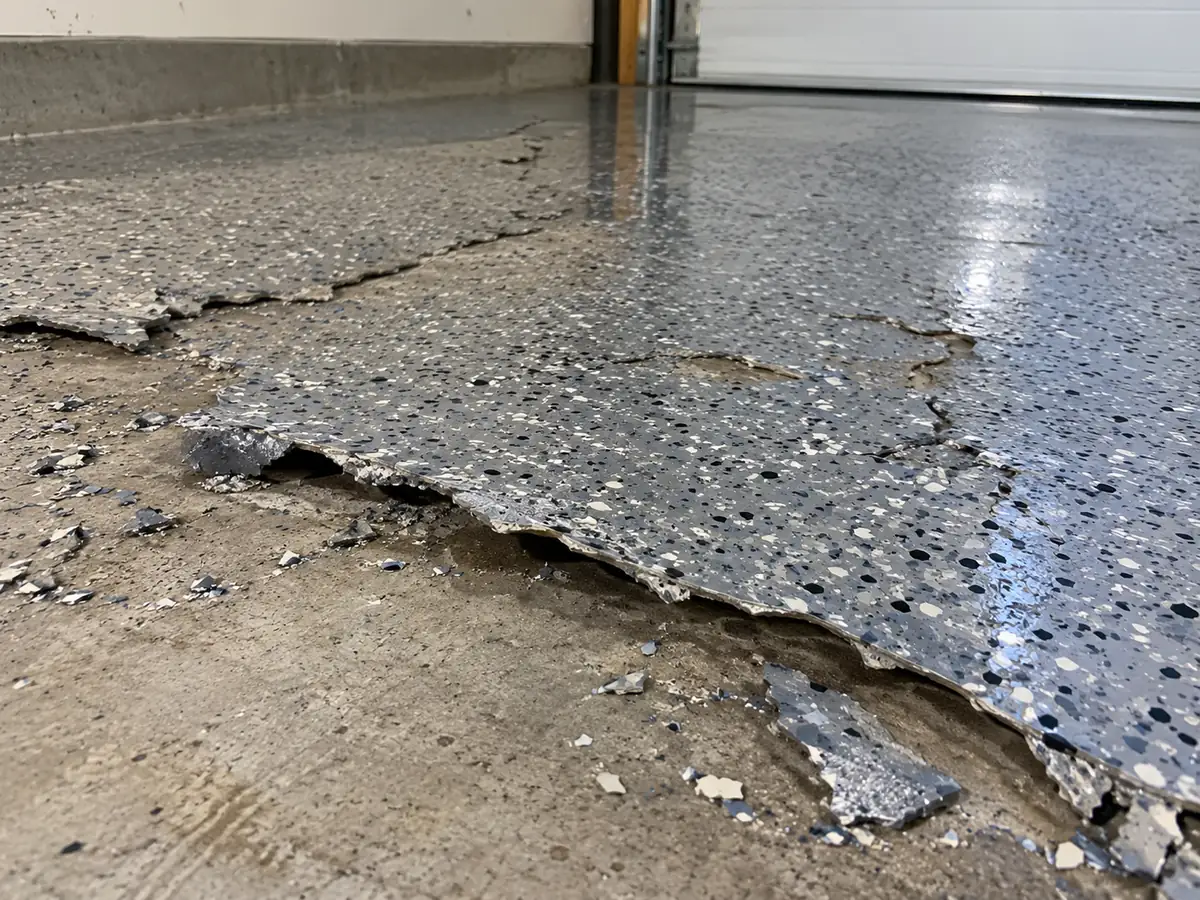
A good share of the floors we quote in Greater Vancouver already have a coating on them. Some were a weekend kit. Plenty were paid for. The peeling looks the same either way: tire-shaped patches in the parking spots, blisters by the floor drain, flake coming up along the garage door. Before we can put a new floor down, the failed one has to be ground off, and that is a cost the homeowner pays on top of the first install.
Almost none of those failures were bad luck. They trace back to a handful of shortcuts that are easy to spot before you sign anything, if you know what to ask. This guide covers why epoxy floors fail, the questions that expose a shortcut, the red flags in a quote, and how to check a contractor in BC.
Why Epoxy Floors Fail
Epoxy floors fail when the coating loses its grip on the concrete, and the cause is usually the prep, not the product. Resin bonds to clean, open, profiled concrete. Put it on a smooth, dusty, damp or previously sealed slab and it sits on top like a sticker, waiting for a hot tire or moisture from below to pull it off.
| What you see | What usually caused it | What prevents it |
|---|---|---|
| Peeling in tire-shaped patches | Hot tire pickup on a weakly bonded or thin coating | Diamond grinding, a bonded base coat, a hard polyaspartic topcoat |
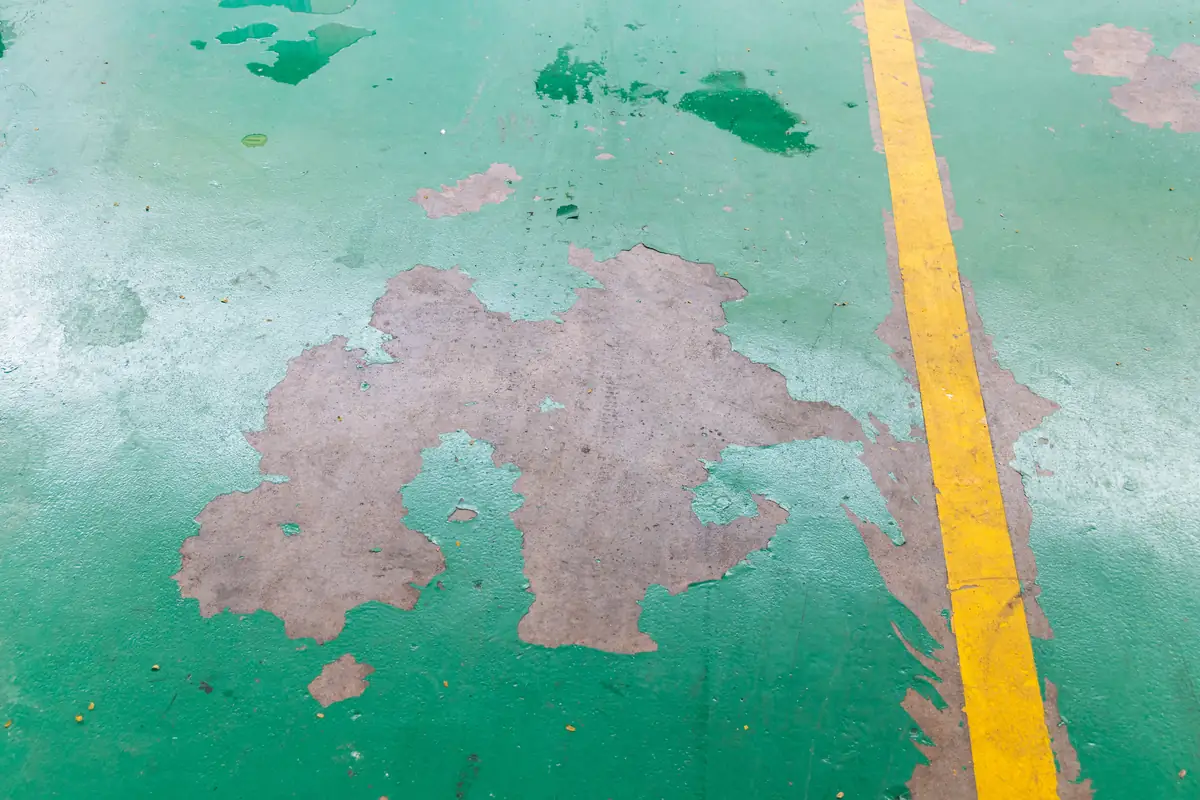
| Blisters or hollow spots weeks after install | Moisture vapour pushing up through the slab | A moisture test before work starts and a mitigating primer where readings call for it |
| Sheets lifting at the edges and door | Acid etching or no prep, so there was never a profile to grip | Grinding to the profile the coating's data sheet asks for, edges included |
| Cracks showing through the new floor | Cracks coated over without being opened and filled | Cracks routed and filled with a flexible polyurea filler before coating |
| Yellowing and fading near the door | An epoxy topcoat left exposed to UV | A UV-resistant polyaspartic topcoat |
| Brown tire stains that resist scrubbing | Chemicals in the tire rubber migrating into a soft topcoat | A hard, dense topcoat and a lighter, busier flake blend |
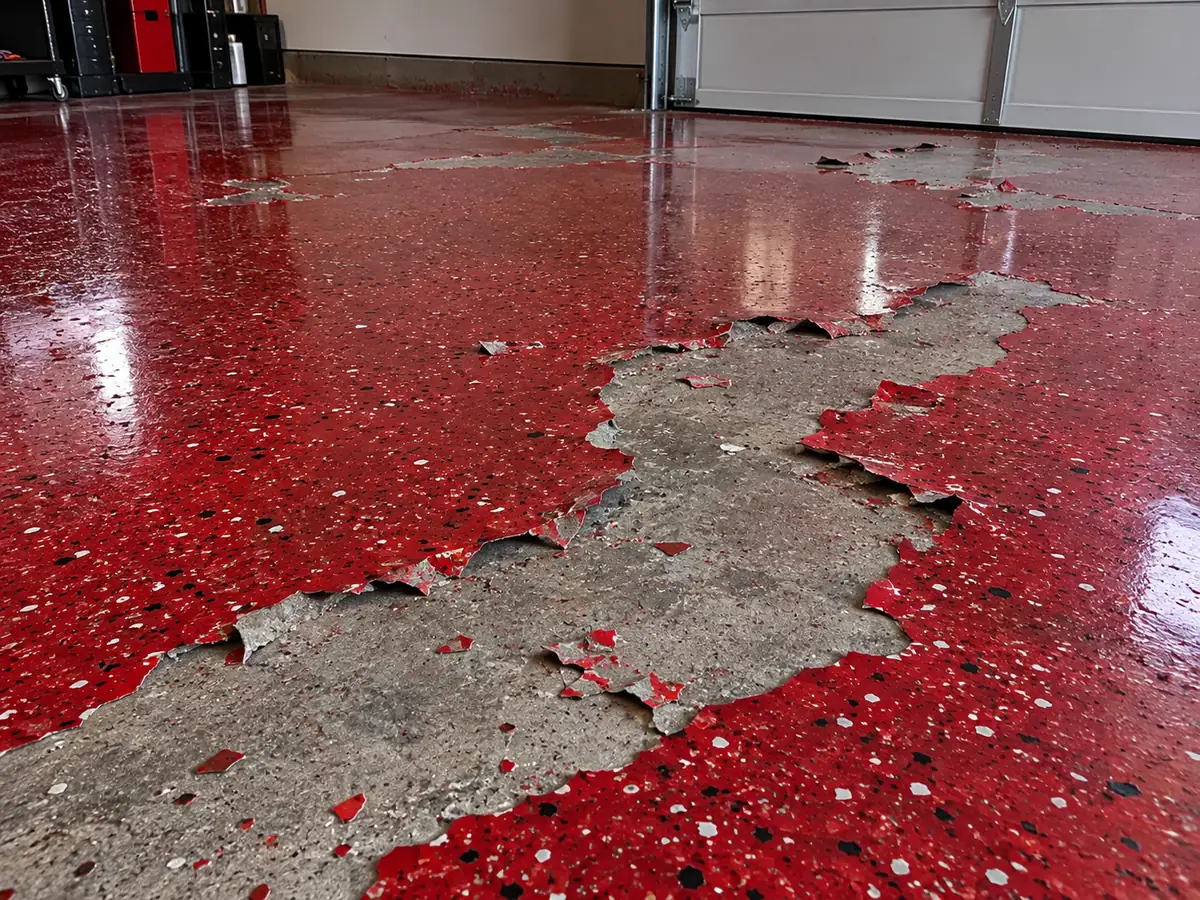
Prep is where most floors are won or lost
Freshly finished concrete has a weak, powdery top layer called laitance. It has to come off. The industry measures prepared concrete on the International Concrete Repair Institute concrete surface profile scale, and most floor coatings want a CSP 2 to 3, which is roughly the texture of medium sandpaper. A diamond grinder gets there. Acid etching, the prep most DIY kits call for, cleans the surface but does not reliably reach that profile, and it leaves residue that has to be neutralized and rinsed out of a slab that then needs to dry. We cover the machines and the profiles in detail on our concrete grinding and floor prep page.
Moisture is the Lower Mainland problem
Metro Vancouver slabs sit over wet ground. Richmond and Delta are built on the Fraser delta, older basements across Burnaby and Coquitlam were poured before vapour barriers were standard, and the rainy season pushes water tables up every winter. That vapour rises through the concrete and presses on the underside of the coating. A floor that looks fine in August can blister in January. Our guide to moisture vapour and epoxy floors explains the testing and the fix.
Hot tire pickup is a bond problem
A tire coming off the highway in July is hot enough to soften a thin or weakly bonded coating. The rubber grips it, and as the tire cools it pulls the coating up with it. Store-bought and water-based products are the usual victims, which is why we compare them directly in epoxy floor paint vs epoxy coating. On a ground slab with a bonded base and a polyaspartic topcoat, hot tire pickup is rare enough that our warranty covers it.
Questions to Ask Before You Hire an Epoxy Flooring Contractor
Any contractor can quote a number. The answers below tell you what that number actually buys. Here is what to ask, and what a good answer sounds like.
- How do you prepare the concrete? You want to hear "diamond grinding", with the edges done too, and a HEPA vacuum on the grinder. If the answer is acid etching, a scrub, or "we clean it really well", that is the floor on this page.
- Do you test the slab for moisture, and how? A calcium chloride test following ASTM F1869 or an in-slab relative humidity test following ASTM F2170, done before work starts, with a plan for what happens if readings come back high.
- What are the layers, in order? A real answer names each coat: primer or base, flake or colour, topcoat, and what each one is made of. "It's a two-part epoxy" is not a system.
- What happens to the cracks and joints? Cracks should be opened and filled with a flexible filler before coating. Control joints are either filled or honoured, and the contractor should tell you which.
- What does the written warranty cover, and for how long? Named failures and a named term, in writing, attached to the quote.
- Are you insured and covered by WorkSafeBC? Liability insurance for damage to your property, WorkSafeBC coverage for the crew. Both should be easy to prove.
- Who runs the crew on install day? Ask who the site lead is and how to reach them while the floor is going down.
- Can I see floors you have done? Photos of recent jobs, ideally including the prep stage as well as the finished shine.
Red Flags in an Epoxy Floor Quote
Most bad floors were visible on paper first. These are the red flags we see most often on the quotes homeowners show us.
- A price over the phone with no look at the slab. Nobody can know the prep, the cracks or the moisture without seeing the floor. A range to budget with is fine. A firm number is a guess.
- Acid etching instead of grinding. It is the shortcut behind most of the peeling floors we remove.
- No moisture test, or a test that happens after you sign. On a Lower Mainland slab, that is the difference between a primer and a callback.
- A one-day install with no grinding in the schedule. Fast systems are real; our own 1-Day system goes in over a single day. The grinding still happens first.
- A quote with no layers, no thickness and no warranty terms. If it only says "epoxy floor, two-car garage", you cannot hold anyone to anything.
- The whole job paid up front. A deposit to book the date and order materials is normal. Paying for the finished floor before it exists is not.
- A warranty that only covers the product. Material warranties come from the manufacturer and usually exclude application. You want the installer's warranty on the floor itself.
The cheapest floor is the one you only pay for once. Grinding off a failed coating, retesting the slab and reinstalling costs more than doing the prep properly the first time. When two quotes are far apart, compare the prep and the warranty line by line before comparing the totals.
How to Check an Epoxy Contractor in BC
Checking a contractor in BC takes very little time and costs nothing. Ask for three documents and one conversation.
- A WorkSafeBC clearance letter. It confirms the business is registered and paying its premiums. WorkSafeBC advises homeowners to get one for each contractor, because you can be held jointly liable for unpaid premiums if a contractor you hire does not pay. You can request a clearance letter yourself.
- A certificate of liability insurance. Coating work involves grinders, solvents and your garage door, your drywall and your car. Make sure the policy is current.
- A written quote. Prep method, moisture test, crack repair, each coat, the finish, the warranty term, and what is excluded.
- A walkthrough of the slab. The contractor should look at the concrete, ask how old the house is, look for old sealers, and talk about where the water goes. That conversation tells you more than any website.
Grinding concrete makes crystalline silica dust, which is why WorkSafeBC regulates silica exposure. A contractor who grinds with vacuum extraction is protecting their crew and keeping dust out of your house at the same time.
What Getting It Right Looks Like
Every floor we install follows the same order, whether it is a single-car garage in Kitsilano or a shop floor in Langley.
- We look at the slab and give you a written quote that names the system and the warranty, and the slab is moisture tested before work starts.
- We diamond grind the whole floor, edges included, with HEPA vacuum extraction on the grinders.
- Cracks are routed and filled with a flexible polyurea filler.
- The coating goes down layer by layer to the system in the quote: a polyaspartic base on our 1-Day system, or an epoxy primer and pigmented polyurea base on our 2-Day system, then a full flake broadcast and a UV-resistant polyaspartic topcoat.
- You get the written warranty with the finished floor.
Our crews have completed 500+ floors across BC, are fully insured and WCB covered, and every flake floor carries a written warranty: 5 years exterior and 10 years interior on the 1-Day system, 10 years exterior and 20 years interior on the 2-Day system. Both cover adhesion failure, delamination, peeling, yellowing or ambering, and hot tire pickup. The differences between the two systems are laid out on our 1-Day vs 2-Day flake system page, and if you already have a failing floor, our epoxy floor resurfacing page covers what removal and recoating involve.