Epoxy Floor Paint vs Epoxy Coating Vancouver
Epoxy floor paint and an epoxy floor coating are not the same product, even though the cans say the same word. Epoxy paint is a one-part latex paint with a little epoxy resin mixed in. It dries in the air and lasts 2 to 4 years in a garage. An epoxy coating is a two-part resin and hardener that cures into ground concrete and lasts 10 to 15 years. In a Vancouver garage with wet tires and slab moisture, that difference shows up by the second winter.
Garage Floor Paint vs Epoxy Coating Side by Side
Most people who search for epoxy floor paint are standing in a hardware store aisle looking at a one-part can, and most people who search for an epoxy coating are thinking about a two-part system that a crew installs. They cost very different amounts and they last very different lengths of time. Here is how they stack up on a Vancouver garage floor that parks a car through the winter.
| Factor | Latex floor paint | One-part epoxy paint | Professional epoxy coating |
|---|---|---|---|
| What it is | Water-based acrylic paint sold for floors | Latex paint with a small amount of epoxy resin added | Two-part resin and hardener, 100 percent solids, usually with a polyaspartic topcoat |
| How it sets | Dries in the air | Dries in the air | Cures by chemical reaction, then bonds into the ground concrete |
| Prep it gets | Sweep and wash | Wash and acid etch | Diamond grinding, moisture test, crack repair, primer |
| Hot tires | Lifts within the first season | Lifts within 1 to 3 years | Highly resistant; covered by our written warranty |
| Road salt, oil, brake fluid | Stains and softens | Stains; solvents can soften it | Wipes off a cured floor |
| Slab moisture | Peels from underneath | Peels from underneath | Moisture tested first; a vapour barrier primer goes on when the slab needs it |
| Lifespan in a Vancouver garage | 6 to 18 months with a car parked | 2 to 4 years | 10 to 15 years |
| Cost | A few cans from the hardware store | A few cans, more than latex | $5 to $12 per sq ft installed |
| Warranty | None on the floor | None on the floor | Written warranty, 10 to 20 years interior by system |
Lifespans are what we see on Lower Mainland garage floors that park a vehicle. A dry storage garage with no car in it gets longer out of any of the three.
How to Tell Epoxy Paint from Epoxy Before You Buy
The word epoxy on a can tells you almost nothing. The label details do. Four things separate a paint from a coating, and you can check every one of them in the aisle.
| Look for | Paint | Coating |
|---|---|---|
| Number of containers | One can. Open it and roll. | Part A and Part B, mixed before use, with a pot life printed on the label |
| Solids content | Not usually printed. Water-based, so much of the can evaporates. | Stated on the data sheet. Professional systems are 100 percent solids: what goes on the floor stays on the floor. |
| Prep instructions | Clean and etch | Mechanical profile, meaning grinding or shot blasting |
| Dry film thickness | Around 2 to 3 mils per coat, about the thickness of a plastic bag | Roughly 10 to 30 mils across the system, depending on the build |
The two-part kits sold at hardware stores sit between the columns. They are real epoxy, but water-based, so the cured film is thin, and the instructions call for acid etching instead of grinding. On a Richmond or Delta slab that carries moisture, that thin film blisters. The full ranking of every garage floor option is in our garage floor coating options guide.
Why Garage Floor Paint Peels in Vancouver
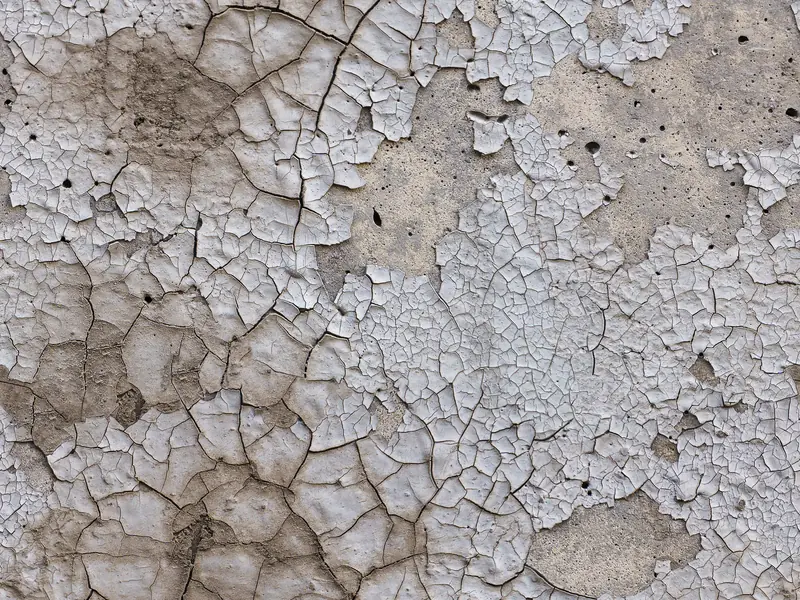
Garage floor paint peels because it never had a grip to begin with. Paint dries on top of the slab. It does not soak into the pores or bond chemically, so it hangs on by surface tack alone. Then a Lower Mainland garage goes to work on it.
- Hot tires. A tire that has just come off Highway 1 is warm enough to soften a thin film. Park on it, let it cool, and the paint comes away with the tread when you back out.
- Slab moisture. Many slabs from Richmond to Surrey sit close to the water table, and older homes were poured without a vapour barrier. Moisture rises through the concrete and pushes the paint off from underneath, which is why it blisters in patches nowhere near the car. Our moisture vapour guide covers what that looks like.
- Road salt and brake fluid. November to March, every car drags salty water in. It soaks through paint and stains the concrete below. Brake fluid and gasoline soften the film outright.
- No surface profile. Paint goes over swept or etched concrete. Etching cleans the surface but leaves the weak top layer, called laitance, in place. A coating bonds to that layer and lifts with it.
The photo above is what we grind off before most garage coatings in Vancouver. It is the most common starting condition we see.
What a Professional Epoxy Coating Does Differently
An epoxy floor coating is a layered system installed over ground concrete, and every layer has one job. This is how a garage floor goes in with us.
- Moisture test. The slab is tested before anything goes on it, using the ASTM F2170 in-slab probe method or the ASTM F1869 calcium chloride test. The reading decides whether a standard primer is safe or whether the floor needs a moisture vapour barrier primer.
- Diamond grinding. Grinders with dust extraction cut the laitance off and open the pores so the coating can key into the concrete. Shot blasting is used only when a product's data sheet calls for it.
- Crack repair. Cracks are routed and filled with a flexible polyurea filler, and spalls are patched, so the surface is sound before it is coated. Details are on the garage floor crack repair page.
- Base coat. A 100 percent solids epoxy or polyaspartic base, depending on the system, rolled to the film thickness the manufacturer specifies.
- Flake broadcast. Vinyl flake is broadcast to full coverage for texture, grip and a finish that hides dust and tire marks.
- Polyaspartic topcoat. A UV-stable, chemical-resistant clear coat that is highly resistant to yellowing and hot tire pickup.
Two flake systems are available. The 1-Day system uses a polyaspartic base and topcoat and carries a written 5-year exterior and 10-year interior warranty. The 2-Day system adds an epoxy primer and grout coat under a pigmented polyurea base, and carries a 10-year exterior and 20-year interior warranty. Both get the same grinding, moisture testing and crack repair. The 1-Day vs 2-Day comparison explains how to choose, and the flake epoxy flooring page shows the finishes.
You may have read that one-day coatings fail. Some do, when a company skips the grind and stacks coats on an unprepared slab to hit the schedule. The install length is not what makes a floor last. The prep underneath it is, and our 1-Day floors get the same grinding and moisture testing as our 2-Day floors, with a written warranty on both.
When Garage Floor Paint Is the Right Call
Paint is the right choice more often than a coating company likes to admit. It costs a few cans and a weekend, and in the right garage that is all it needs to be.
- Storage-only garages. No car, no hot tires, no road salt. A one-part epoxy paint on a dry, clean slab can look fine for years.
- A house going on the market. A fresh coat of floor paint makes a garage photograph better for the listing and costs very little. Tell the buyer it is paint.
- Detached workshops with light foot traffic. A painted floor cuts concrete dust, which is most of what people want.
- A slab that cannot be coated yet. If the concrete is less than 28 days old, or has an active leak, no coating should go on it. Paint as a stopgap is fine as long as you expect to grind it off later.
Where paint is the wrong call is any garage that parks a car in a Vancouver winter. Repainting every couple of years costs weekends, and every layer has to be ground off before the floor can ever be coated properly. A penetrating concrete sealer is often the better cheap option for a bare slab, because it soaks in rather than sitting on top, and it does not need to be removed later.
Painted Floor Already Peeling? Here Is the Fix
A peeling painted floor cannot be coated over, and it cannot be repainted for long either, because the new paint bonds to the old paint and lifts with it. The floor has to go back to bare concrete first.
On a paint removal job we diamond grind the entire slab, not just the loose patches. Grinding takes off the paint, the laitance under it, and any oil the paint was hiding. Then the slab is moisture tested, cracks are routed and filled, and the coating goes down on concrete that has never been coated properly before. Old paint removal is assessed on site and included in your written quote. If the slab has other problems, such as spalling or old carpet adhesive, our floor resurfacing page covers what is involved.
What a Coated Garage Floor Costs in Vancouver
A professionally installed garage floor coating in Greater Vancouver runs $5 to $10 per square foot for solid colour epoxy and $6 to $12 per square foot for a flake or polyaspartic system. A single-car garage typically lands between $2,000 and $3,500 installed, and a two-car garage between $2,000 and $4,000. The ranges include grinding, moisture testing, crack repair, the coating system and cleanup. Old paint removal and moisture mitigation are assessed on site and included in your written quote. GST (5%) is additional.
Against a painted floor, the arithmetic is simple. Paint costs less on the day and gets redone every year or two, or every 2 to 4 years for a one-part epoxy paint, with the old layers ground off before any coating. A coating goes on once and typically runs 10 to 15 years under a written warranty. Full pricing by system and garage size is in the Vancouver epoxy flooring cost guide, and the full garage service is on the garage epoxy floor page.
Epoxy Paint vs Epoxy Coating: Frequently Asked Questions
Garage Floor Coatings Across Greater Vancouver
We grind off failed paint and install epoxy and polyaspartic garage floors throughout Metro Vancouver and the Fraser Valley.
Get a Free Garage Floor Assessment
We will look at the slab, test it for moisture and tell you whether it needs a coating or whether paint or a sealer will do the job. You get a written quote either way.