Concrete Grinding Vancouver
Concrete grinding removes what is on a slab and the weak layer under it, and leaves a surface a coating can grip. We grind failed epoxy, garage floor paint, tile thinset, carpet glue and sealers back to bare concrete, take down high spots and joint lippage, and profile the slab for whatever goes on next. Every grinder runs on HEPA extraction. Garages, basements, shops and commercial floors across Greater Vancouver.
What Concrete Grinding Removes and Fixes
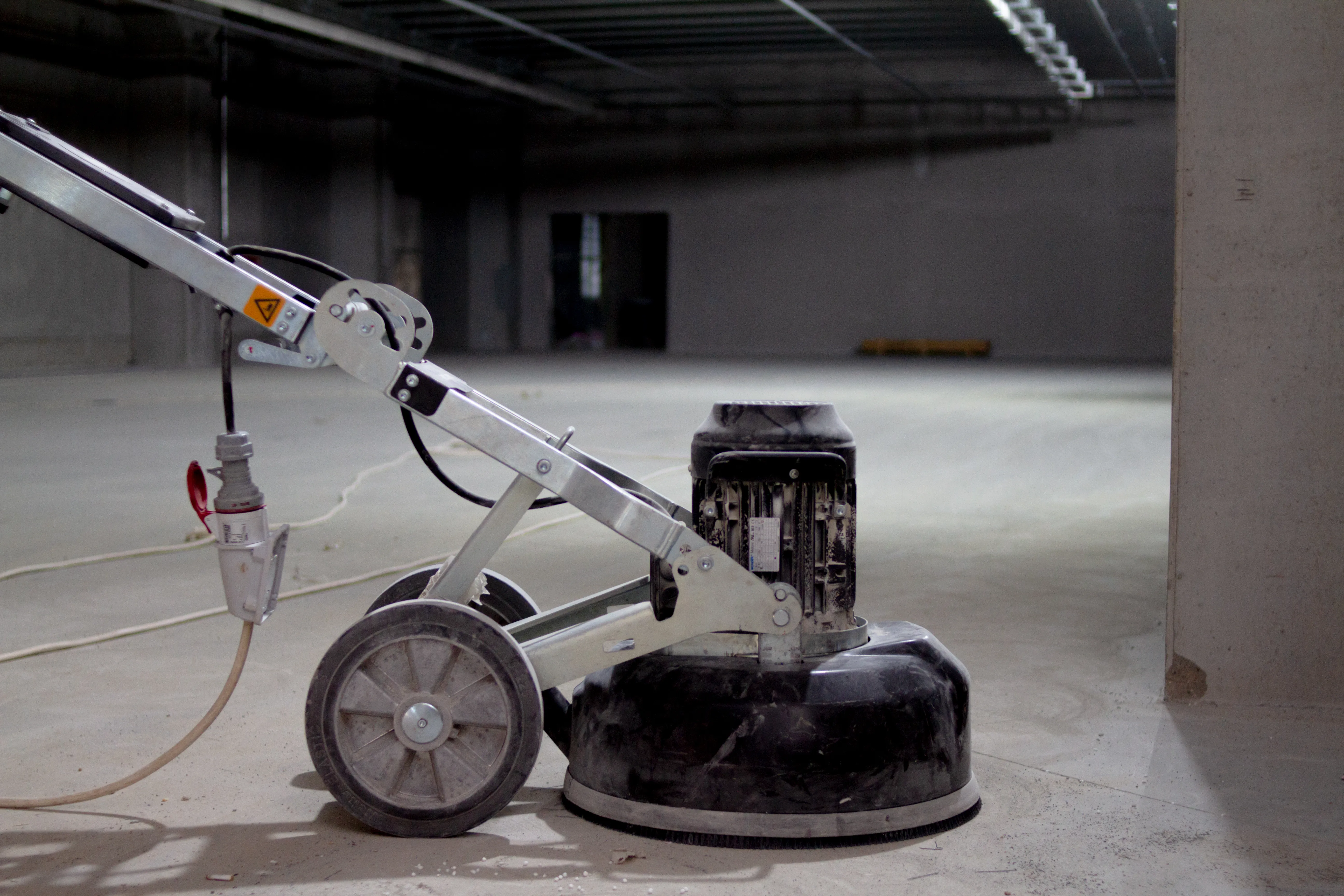
A concrete grinder is a heavy planetary machine with diamond segments on rotating heads. As it moves across the slab it cuts off a thin layer of the surface, anywhere from a fraction of a millimetre to a few millimetres per pass depending on the tooling. Everything that comes off goes into a HEPA vacuum. What is left is clean, open concrete with a texture like fine sandpaper.
That one process does four different jobs on a Lower Mainland floor.
- Coating and adhesive removal. Failed epoxy, hardware store floor paint, sealers, tile thinset, carpet and vinyl glue, and old cementitious toppings all come off. What is peeling is the easy part; the bonded remainder is what needs the machine.
- Laitance removal. Every slab cures with a weak, powdery layer on top. A coating applied over it bonds to the laitance, and the laitance lets go of the concrete. Grinding takes that layer off so the coating bonds to sound material.
- High spots and lippage. Ridges at control joints, humps from a bad float, and steps where two pours meet are ground flat. This is most of what people mean by levelling a garage floor.
- Surface profile. The texture left behind is what a coating keys into. Coatings specify the profile they need, and grinding is how it is produced on an existing slab.
Grinding is the first step of every floor we install, and it is also available on its own when a slab needs to be cleaned up before tile, vinyl, or a sealer.
When Is Concrete Floor Grinding Required Before Floor Coverings?
Grinding is required before any coating that bonds to the slab, such as epoxy, polyaspartic, urethane cement or a polished finish, and it is required under tile or vinyl plank when the slab has old adhesive, paint, ridges or high spots beyond the flooring's flatness tolerance. A floating floor on a clean, flat slab does not need it.
| Floor going on | Grinding needed? | Why |
|---|---|---|
| Epoxy, polyaspartic, urethane cement | Always | The coating bonds only to profiled, laitance-free concrete. Acid etching does not achieve this. |
| Polished concrete | Always | Polishing is a grinding sequence; the coarse cut is the first step. |
| Ceramic or porcelain tile | Usually | Old thinset, paint and ridges must come off, and high spots will show in large-format tile. |
| Vinyl plank or sheet vinyl | When high spots exceed the manufacturer's flatness spec | Vinyl telegraphs every ridge; adhesive residue also has to go for glue-down vinyl. |
| Penetrating sealer | When the slab has paint, sealer or heavy contamination | A penetrating sealer cannot soak through an old film. |
| Floating laminate or engineered wood | Only for high spots | The floor is not bonded, so adhesive residue does not matter, but a hump will rock the planks. |
If you are choosing a coated finish, the garage floor coating page and the polished concrete page both include grinding in the floor price.
Grinding, Shot Blasting or Scarifying
Three machines do mechanical surface preparation, and they are not interchangeable. Diamond grinding covers most residential and commercial work. Shot blasting and scarifying are for specific situations, and a coating's data sheet sometimes names the one it wants. Our default is diamond grinding, with shot blasting brought in when the data sheet specifies it.
| Method | How it works | Profile produced | Used for |
|---|---|---|---|
| Diamond grinding | Rotating diamond segments cut the surface; HEPA vacuum collects the dust | CSP 1 to 3, depending on the tooling | Coating and adhesive removal, laitance, high spots, prep for epoxy, polyaspartic, tile and polish |
| Shot blasting | Steel shot fired at the slab and recycled by the machine | CSP 2 to 9, set by the shot size and travel speed | Large open commercial and industrial floors where a thick system's data sheet calls for it; not for edges or small rooms |
| Scarifying | Carbide cutters on a drum chip the surface away | CSP 4 to 9, very rough | Thick coatings, heavy toppings, and taking off several millimetres fast; usually followed by grinding to smooth the result |
Shot blasting is usually a large industrial floor job, covered on the industrial and warehouse flooring page.
What CSP Means and Why Coatings Specify It
Concrete surface profile, or CSP, is a scale from 1 to 10 published by the International Concrete Repair Institute that describes how rough a prepared slab is. CSP 1 is close to smooth. CSP 10 is deeply scarified. Every coating manufacturer states the CSP its product needs, and a floor installed on the wrong profile is far more likely to lift.
| System | Typical CSP | How it is produced |
|---|---|---|
| Thin-film epoxy, garage flake, polyaspartic | CSP 2 to 3 | Diamond grinding, coarse metal-bond tooling |
| High-build epoxy, quartz broadcast | CSP 3 to 4 | Grinding with coarser tooling or shot blasting |
| Urethane cement, trowel-applied systems | CSP 4 to 6 | Shot blasting or scarifying then grinding |
| Polished concrete | Sequence from coarse to fine | Grinding through progressively finer diamonds |
Acid etching, the prep that most DIY kits and floor paints call for, does not reach CSP 2. It roughens the surface slightly and leaves the laitance in place, which is the main reason painted and kit floors fail on Lower Mainland slabs. The comparison is on our epoxy floor paint vs epoxy coating page.
Removing Epoxy, Paint, Thinset and Glue
What is on the floor decides the tooling, the number of passes and the time. This is what we see most often in Metro Vancouver garages and basements, and how it comes off.
| On the floor | Typical passes | Notes |
|---|---|---|
| Garage floor paint, one-part epoxy paint | 1 | Thin film; comes off with the laitance in one pass |
| Failed DIY epoxy kit | 1 to 2 | Peeling areas come off easily; bonded areas need the second pass |
| Thick 100 percent solids epoxy | 2 to 4 | Well-bonded and hard; aggressive tooling and extra passes |
| Tile thinset and mortar beds | 2 to 3 | Tile is removed first; ridges of thinset are ground flush |
| Carpet and vinyl adhesive | 1 to 2 | Softens under heat; specialised tooling stops it gumming the segments |
| Acrylic or urethane sealers | 1 | Thin; must come off before any bonded coating |
| Oil-soaked concrete | 1 plus degreasing | Grinding exposes the stain; the area is degreased and tested before coating |
Edges and corners are done with a hand grinder under its own vacuum, because the large machine cannot reach the last few centimetres at a wall. A floor that has been ground and then coated is covered on the floor resurfacing page.
What Grinding Cannot Do
Grinding removes material. It cannot add any. That sets a few limits worth knowing before you book.
- Low spots stay low. Minor hollows are filled as part of the coating build, for example with a thicker self-levelling epoxy layer. A floor that needs real levelling needs it done before we coat, and cementitious floor levelling is not a service we offer.
- A sloped slab stays sloped. Grinding can take a hump out, but it cannot bring a slab that falls 20 mm across a garage back to level.
- Structural cracks are not a grinding problem. Cracks are routed and filled with a flexible polyurea filler after grinding; the crack repair page covers what is and is not fixable.
- Green concrete. A slab needs about 28 days of cure before it is ground and coated.
- We do not rent grinders. Rental machines from hardware stores are light-duty and usually lack proper extraction. If you want to do the prep yourself, a tool rental company is the right call; if you want the floor coated afterwards, it is cheaper to have us grind it as part of the job.
Concrete Grinding Cost
Grinding on its own is quoted per project. What is on the floor, how thick it is, how well it is bonded and how much of the slab needs work set the price, and none of that can be judged without seeing the floor. You get a written quote after an on-site look.
When grinding is part of a coated floor, it is included in the floor price rather than charged separately. Garage floor coatings run $5 to $12 per square foot installed depending on the system, and resurfacing a failed floor, which includes grinding off the old coating, runs $7 to $12. Other systems are priced in the cost guide. Both are laid out in the Vancouver epoxy flooring cost guide. GST (5%) is additional.
Concrete Grinding: Frequently Asked Questions
Concrete Grinding Across Greater Vancouver
We grind and prepare concrete floors throughout Metro Vancouver and the Fraser Valley, and take larger commercial and industrial grinding projects anywhere in BC.
Book a Free Grinding Assessment
Tell us what is on the floor and how big it is. We will look at the slab, tell you what will come off and how many passes it needs, and send a written quote, with a coating or sealer included if you want the floor finished.