Short answer: Epoxy flooring is a two-part resin coating that cures into a hard, continuous layer bonded to concrete. It resists oil, salt and wear, cleans with a mop, and typically lasts 10 to 15 years or more when the slab is properly ground and tested first. Its weak points are prep, UV and moisture.
Most people first look into epoxy when they are looking at a dusty garage slab, a cold basement, or a shop floor soaked in oil. The term gets used loosely, for everything from a can of floor paint to a multi-layer commercial system, so it helps to know what it actually is before comparing quotes. This guide covers what it is made of, the types, the honest pros and cons, how long it lasts, and where a DIY kit differs from a professional install.
What Is Epoxy Flooring Made Of?
An epoxy floor is made from two liquids: an epoxy resin and a hardener, usually called part A and part B. Mixed together they react and cure into a rigid plastic that bonds to the concrete underneath. The mix has a working time, so it has to be spread before it starts to set, which is one reason installs follow a tight order.
Not every product sold as epoxy is the same. Professional systems generally use high-solids resins, so nearly everything rolled onto the floor stays there as film. Many DIY kits are water-based: part of what goes on is water that evaporates. The dry coat that stays behind is much thinner than the wet layer looked. Thickness is a big part of why the two perform so differently.
Epoxy vs floor paint
Epoxy cures by a chemical reaction and bonds into a prepared slab. Floor paint dries as the liquid evaporates and sits on the surface. Our paint vs epoxy coating comparison goes through the difference in detail.
Types of Epoxy Floors
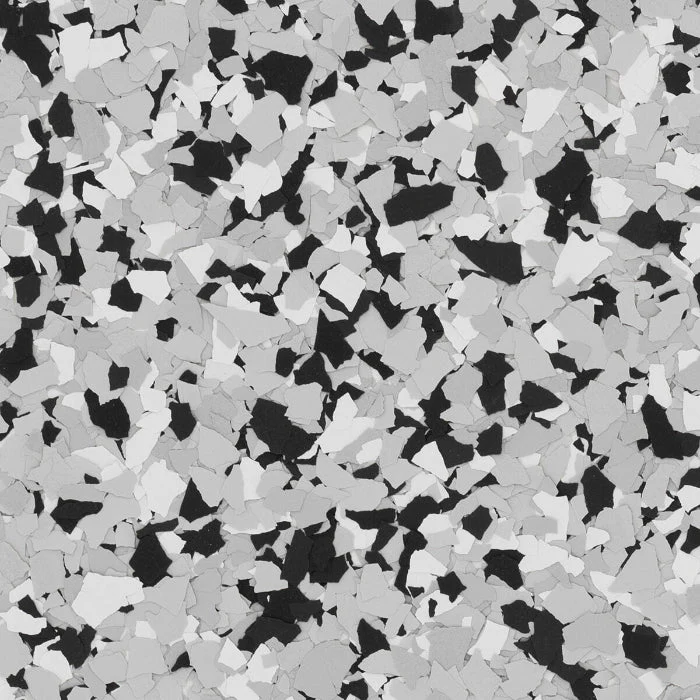
- Flake epoxy. Vinyl chips broadcast into the base coat for texture and a speckled, stone-like look. The most popular garage and basement floor.
- Solid colour epoxy. One colour, clean and simple, the lowest-cost system.
- Metallic epoxy. Pearlescent pigments that move in the resin for a marbled, three-dimensional look.
- Quartz epoxy. Coloured quartz sand broadcast in layers for a tough, slip-resistant floor in kitchens and wet areas.
- Self-levelling epoxy. A thicker pour that flows flat for a smooth, glassy finish.
Most modern garage systems finish with a polyaspartic topcoat rather than a clear epoxy, because polyaspartic is far more resistant to UV and yellowing. Our epoxy vs polyaspartic guide compares the two.
Epoxy Flooring Pros and Cons
| Pros | Cons |
|---|---|
| Resists oil, road salt and most garage chemicals; wipe up brake fluid and solvents promptly | Only as good as the prep: grinding and moisture testing are not optional |
| Seals the slab, so no more concrete dust | Standard epoxy yellows in sunlight without a UV-resistant topcoat |
| Wipes clean with a mop or squeegee | Sensitive to moisture coming up through the slab |
| Bright finish that reflects light | Smooth finishes can be slippery when wet unless grit is added |
| Many looks: flake, metallic, solid, quartz | Cold slabs slow curing, so winter installs need planning |
| Can be recoated instead of replaced | Not a fix for a cracked, heaving or failing slab |
How Long Does an Epoxy Floor Last?
A professionally installed epoxy floor typically lasts 10 to 15 years or more, and our 2-Day flake system carries a written warranty of up to 20 years on interior floors. The floors that fail early almost always fail for the same few reasons, and the resin itself is rarely one of them:
- Prep. Coating bonds to open, profiled concrete. The International Concrete Repair Institute publishes the concrete surface profile (CSP) scale that coating makers use to specify how rough a slab must be, and acid etching rarely gets there. Diamond grinding does.
- Thickness. Thin films wear through in the traffic lanes and parking spots first.
- Topcoat. A hard, UV-resistant topcoat protects the colour layer from scratches, sun and hot tires.
- Moisture. Vapour pushing up through the slab can blister a coating from below, which is why we test every slab. More on that in our moisture vapour guide.
- Use. A home garage, a busy shop and a warehouse with forklifts need different builds.
Is Epoxy Flooring Worth It for Your Space?
| Space | Worth it? | Why |
|---|---|---|
| Garage | Usually yes | Stops dust and stains, handles road salt, turns the garage into usable space |
| Basement | Yes, after a moisture test | One continuous surface, easy to clean, no grout lines to hold damp |
| Shop or commercial | Yes | Chemical and abrasion resistance, bright, easy to keep clean |
| Uncovered outdoor slab | Use a polyaspartic system | Standard epoxy yellows in sun; exterior floors need UV-stable coatings |
| Inside the home on concrete | Often | Kitchens, laundry and mudrooms on slab; see our residential page |
Is it expensive? An epoxy floor costs more than paint and less than most tile or stone, and it is priced per square foot by system. Our Vancouver cost guide lists current ranges and what adds to them.
DIY Epoxy Kits vs a Professional Install
Garage kits from the hardware store are the most common way people try epoxy, and the most common floor we grind off. The product is not the whole story. The difference is mostly in what happens before and after the coat goes on.
| Typical DIY kit | Professional system | |
|---|---|---|
| Prep | Acid etch or scrub | Diamond grinding with HEPA dust extraction |
| Moisture | Not tested | Slab tested before work starts |
| Cracks | Coated over | Routed and filled with a flexible filler |
| Coating | Thin, often water-based | High-solids base, full flake broadcast |
| Topcoat | Often none | UV-resistant polyaspartic |
| Warranty | Product only | Written warranty on the installed floor |
A kit can make sense on a small, dry, bare slab you are happy to redo in a few years. For a floor you park on through Vancouver winters, the prep is the part that decides the outcome. Our guide to choosing an epoxy flooring contractor lists the questions to ask.
A good epoxy floor is a system, built in layers. Ground concrete, a moisture test, a properly built base and a UV-resistant topcoat are what turn a two-part resin into a floor that lasts.