Outdoor Epoxy Patio Coating Vancouver
Straight answer first: plain epoxy is the wrong product for a Vancouver patio. Epoxy ambers and chalks under UV, so an outdoor concrete coating needs a UV-stable polyaspartic or polyurea topcoat over it. Built that way, a patio, porch, walkway or pool deck handles coastal rain, freeze and thaw, and sun without yellowing, and it carries a written exterior warranty.
Can You Use Epoxy on Outdoor Concrete?
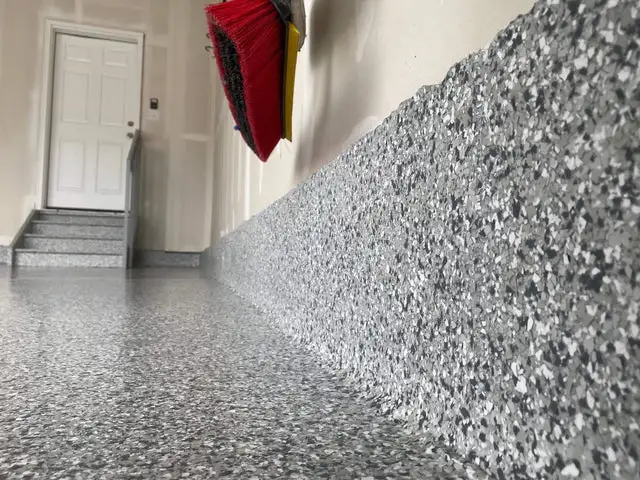
Yes, with one correction to how the question is usually asked. Epoxy works outdoors as a base coat, bonded to properly ground concrete, but it cannot be the surface you walk on. Ultraviolet light breaks down the resin, so a bare epoxy patio turns yellow and chalky within a season or two in Vancouver, and faster on a south-facing exposure.
The outdoor build we use on patios, porches and walkways is an epoxy or polyurea base, a flake broadcast for grip and colour, then a polyaspartic topcoat that is UV stable. The topcoat is what takes the sunlight, and it does not amber. It also cures fast enough to go down between rain windows, which matters here between October and March.
If you have read that outdoor epoxy is a bad idea, that advice is right about the product and wrong about the system. The failures people photograph online are almost always bare epoxy, or a kit rolled onto an unprepared slab that was holding moisture.
- Patios and sundecks on grade. The most common exterior job we quote in Metro Vancouver.
- Front porches, steps and landings. Steps get an extra anti-slip pass, because wet concrete stairs are where people fall. More on coating concrete stairs.
- Walkways and side paths. Usually quoted with the patio since the crew and the grinder are already on site.
- Pool surrounds. Flake with an aggressive slip additive, never a smooth gloss finish.
- Carports and covered parking pads. Same build as a garage floor, with the UV-stable topcoat.
What Rain, Sun and Frost Do to an Outdoor Coating
Greater Vancouver puts four things at an exterior floor that an interior floor never sees, and each one changes how the job is built.
| Condition | What it does | How we build for it |
|---|---|---|
| UV exposure | Breaks down epoxy resin, turning it yellow and chalky | UV-stable polyaspartic or polyurea topcoat, never bare epoxy on the surface |
| Rain most of the year | Keeps the slab wet, drives moisture up from below | Moisture test before coating, mitigating primer where the reading calls for it |
| Freeze and thaw cycles | Water in cracks and pores expands and lifts the surface | Cracks repaired first, a flexible build that moves with the slab |
| Wet feet and slope | A smooth coating is dangerous once it is wet | Flake texture plus a graded anti-slip additive in the topcoat |
| Standing water | Pools at low spots and works into the edges | We check drainage and slope at the assessment and say when a slab needs grading first |
Winter installs are possible here. The limiting factor is surface temperature and dew point on the day, not the calendar, and polyaspartic cures in cooler conditions than epoxy does.
Keeping an Outdoor Patio Coating Safe When It Is Wet
This is the part homeowners underestimate. A gloss coating on a covered patio is fine. The same finish on an open patio in November is an ice rink. Every exterior floor we coat gets texture built in, and the amount is a decision we make with you at the assessment.
- Flake broadcast. The chips themselves create a slightly raised, textured surface. This alone is enough for most covered areas.
- Graded anti-slip additive. Aluminium oxide or a polymer grit blended into the topcoat. We use a finer grade on bare feet areas like pool decks and a coarser grade on steps and ramps.
- Extra pass on stairs and transitions. Treads and the lip of a step get more grit than the open field of the patio.
The trade-off is honest: more grit means more grip and a slightly rougher surface underfoot and to sweep. Tell us how the space gets used, bare feet or boots, and we will match the grade to it.
Outdoor Concrete Coating Cost in Vancouver
Exterior work is priced on the same per square foot basis as an interior flake or polyaspartic floor, $6 to $12 installed, because it is the same crew, the same grinder and a comparable material build. Smaller areas cost more per foot than large ones, since setup and mobilization do not scale down.
| Area | Approx. size | Typical range |
|---|---|---|
| Front porch, steps or landing | 150 to 250 sq ft | $1,500 to $3,000 |
| Patio or sundeck | 300 to 500 sq ft | $2,000 to $6,000 |
| Patio plus walkway | 600 to 900 sq ft | $4,000 to $10,000 |
Ranges include diamond grinding, crack repair, the base coat, flake or pigment, the anti-slip topcoat and cleanup. How much crack repair, spall repair or moisture-mitigating primer a slab needs is assessed on site and included in your written quote. GST (5%) is additional.
For the full pricing picture across every system, see the Vancouver epoxy flooring cost guide. Cracked or spalled patio slabs are covered on the crack repair page.
Exterior Warranty on Patio Coatings
Most coating companies in this market will not put an exterior floor in writing at all, because sunlight and weather are where cheap builds fail. Ours are covered on the same tiers as interior work, with shorter exterior terms because the conditions are harder.
| System | Exterior | Interior |
|---|---|---|
| 1-Day flake system | 5 years | 10 years |
| 2-Day flake system | 10 years | 20 years |
Coverage is for adhesion failure, delamination, peeling, yellowing and hot-tire pickup. The written warranty comes with every quote, so you can read the terms before you decide. The difference between the two builds is explained on the 1-Day and 2-Day systems page.
When an Outdoor Coating Is the Wrong Call
Four situations where we tell people not to spend the money, at the assessment rather than after a deposit:
- Pavers, flagstone or interlock. A coating needs a continuous concrete slab. We do not coat unit pavers.
- Wood or composite decks. Different trade, different product. Deck coatings and vinyl membranes belong to a deck contractor.
- A slab that is heaving or badly settled. Coating follows the concrete. If the patio has lifted or dropped, the ground needs fixing first.
- Water pooling with nowhere to drain. A coating over standing water will fail at the edges. Grading or a drain comes first.
If the slab is sound but the surface is worn, stained or has a failed old coating on it, that is a resurfacing job rather than a new install, and it usually costs less. Polished concrete is an interior finish only, so it is not an option out here.
Coating a concrete balcony or rooftop deck over living space? That needs a flexible waterproof membrane, covered on our balcony and deck waterproofing page. For the driveway, see concrete driveway sealing and coating.
Outdoor Epoxy Patio Coating: Frequently Asked Questions
Patio and Exterior Coatings Across Greater Vancouver
We coat patios, porches, walkways and pool surrounds throughout Metro Vancouver and the Fraser Valley.
Get a Free Patio Coating Assessment in Vancouver
Tell us about the space and we will tell you whether a coating is the right call for that slab. You get a written quote with the prep and repair work already in it.